In modern society, people are increasingly facing psychological pressures such as dwelling on the past, worrying about the future, and being distracted by an overwhelming amount of information that often causes the mind to stray from the present moment.
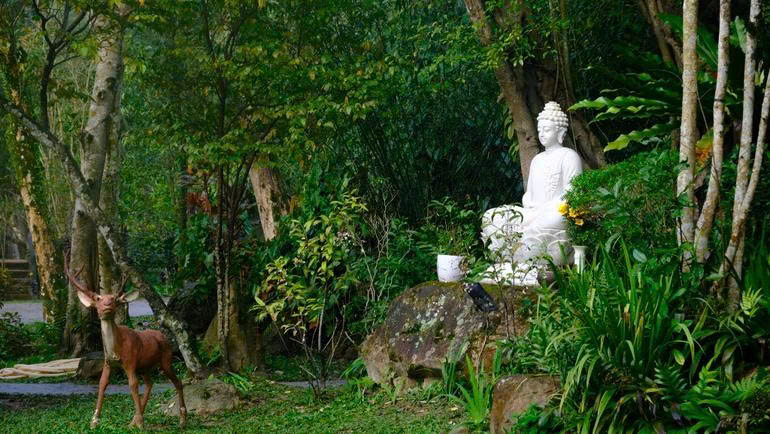
This mental state is not a problem unique to this era, but was recognized by the Buddha more than 2,600 years ago. With profound wisdom, he taught a practical method to help practitioners escape psychological constraints and return to living fully with themselves in the present moment. Among the scriptures that address this issue, the Bhaddekaratta Sutta (1) is one of the most fundamental and concise teachings.
In the sutra, the Buddha encourages practitioners:
Do not dwell on the past,
Do not yearn for the future.
The past is gone,
The future has not yet arrived.
Only the present moment exists,
Wisdom lies here.
The meaning of "living alone" in the sutra is not living in isolation from the community, but living without being bound by the past, not being controlled by the future, knowing how to abide in and deeply connect with the present reality. It is the art of mindful living, a practical practice suitable for all levels of society in today's turbulent world.
A person who knows how to live alone in the scriptures.
The very title of the Bhaddekaratta Sutta, the term "living alone," is easily misunderstood if not approached correctly. Within the Buddhist context, living alone does not mean isolation, seclusion, or complete separation from community life, but rather inner solitude—that is, self-mastery in each moment of consciousness. Parallel texts such as the Bhaddekaratta Suttas (MN 131-MN 134) consistently state that a person who knows how to live alone is not bound by past events and not swept away by future ones.
In the sutta, the Buddha emphasizes: "What belongs to the past, let it pass. What belongs to the future, do not dwell on. Those who skillfully abide in the present moment are worthy of being called those who know how to live alone." Therefore, living alone means living with oneself, seeing oneself clearly, and understanding the workings of phenomena in the present. A person who knows how to live alone is someone who is always mindful of every breath, every step, every thought, every sensation that is happening. They do not let the past drag them away, nor be influenced by the future, and they do not lose themselves in the distractions of the present.
This is the core spirit of the teachings on mindfulness (sati) and awareness (sampajañña). Many other scriptures also clarify this meaning. According to the Mahāsatipaṭṭhāna(2), practitioners are guided to observe and clearly recognize what is happening in body, feelings, mind, and phenomena with awareness. Thus, living alone means living without distraction, without being scattered, but always peaceful and complete in the present moment.
The bonds of the past and the future
One of the central themes of the One Night Sage Sutra is to point out two common psychological tendencies of human beings: dwelling in the past and fantasizing about the future. The Buddha describes this as a fluctuation that prevents the mind from settling down, like a reed wilting in a strong wind.
The past has a special allure, as it carries memories, wounds, successes, pride, and regrets. When a person searches for the past, their mind is bound by things that no longer exist. From the perspective of dependent origination, the past has vanished, but the aggregate of thought continues to recreate images, causing people to be trapped. Buddhist psychology calls this "the hindrance of regret." Regret pulls people back to a past moment, making the present seem dim. As in the Samyutta Nikaya, the Buddha said: "He who indulges in the past, his mind is burned like a fire burning in the wilderness" (3).
On the other hand, the future is the land of imagination, where craving, desires, and fears are nurtured. When the mind wanders towards things yet to come, it detaches itself from the present reality and is easily swayed by the "hindering sensations." People therefore often project onto unreal images, creating anxiety, unease, and pressure. The scriptures liken this state to someone shooting an arrow into the darkness, setting a target only to then fear it.
When caught between the two currents of past and future, the mind loses its ability to see and know directly. Reconstructed memories and unformed plans become a thin mist covering reality, causing people to live with the shadows of experience and illusion rather than with the present moment. Both create subtle bonds: one holding on with regret and hurt, the other propelling with desire and unease. Although their manifestations differ, they both share the same nature of causing the mind to waver, scatter, and stray from what is happening. Therefore, recognizing and letting go of these two bonds is an essential step in being able to dwell in the present moment, the only place where liberation is possible.
The art of dwelling in the present moment according to Buddhist teachings.
The One Night Sage Sutra not only raises the issue but also clearly shows the practical method for abiding in the present moment. This spirit is expressed through three elements: mindfulness, awareness, and insight.
Abiding in the present moment means dwelling in the reality that is unfolding, with complete awareness, without distraction. The Buddha did not require practitioners to forcibly discard the past or the future; what he taught was to see their true nature, understanding that they are merely psychological phenomena. Thanks to this insight, the practitioner is no longer drawn away from the present.
In the power of mindfulness, the practitioner is aware of the breath, body, sensations, and mind at work. This is fully presented in the sutras on mindfulness. However, in the One Night Sage Sutra, the method is expressed in verse, emphasizing the element of awareness in each moment. This is a direct method of meditation, not going into detailed analysis of objects, but emphasizing the experience of being present with the arising phenomena.
Only the present moment exists,
The true wisdom lies here,
Unmoved and unshaken,
Knowing this, one should practice.
When abiding in the present moment, the practitioner does not resist or cling, but sees all phenomena as they truly are. When sadness arises, the practitioner recognizes the sadness. When discomfort arises, the practitioner contemplates it with the wisdom of impermanence. In this way, the mind is no longer swept away by emotions, avoiding the creation of further cycles of suffering. The Buddha taught:
Abiding in this way with fervent devotion,
Day and night without weariness,
Deserving of the title "One Night Sage,"
A tranquil and silent being.
This is a way of living deeply in each moment, experientially. In the Zen tradition, this spirit is expressed through images such as "seeing life through each breath," "seeing spring in a leaf," "seeing the Dharma in each step." Those who know how to return to the present moment no longer seek happiness externally, but discover the source of peace within each moment. This is an art of living that everyone, whether monastic or lay, can practice in their daily lives.
The benefits of being present in the moment, according to the scriptures.
Dwelling in the present moment brings many practical benefits, described in the scriptures as the path to purity, peace, and liberation. According to the One Night Sage Sutra, a person dwelling in the present moment first escapes suffering caused by the past and future. When they no longer pursue the past, they are not tormented by regret or remorse. When they no longer dwell on the future, they are not worried, anxious, or afraid. Therefore, the present moment becomes a moment of freedom and liberation.
In addition, dwelling in the present moment also helps to increase concentration. When the mind dwells in the present moment continuously, concentration arises. Concentration helps the mind become firm, less affected by external circumstances, like a “solid rock that does not move in the wind” (4). This is the foundation for the arising of wisdom.
Furthermore, living in the present moment makes life deeper and more complete. Mindful people know how to enjoy life with a calm mind: eating mindfully, breathing mindfully, walking, standing, lying down, sitting mindfully. Every activity becomes an opportunity to practice, nurturing peace and practical joy. Not only that, those who dwell in the present moment develop compassion and genuine empathy. When the mind is fully present, we are able to listen to others with profound presence. This helps reduce conflict and increase love. In the Samyutta Nikaya, the Buddha said: “Mindfulness increases loving-kindness, making the mind soft as silk” (5).
Finally, the ultimate benefit of dwelling in the present moment is opening the door to liberation. When there is no longer any clinging to any dharma, the mind becomes free. “Without relying on the past, without relying on the future, without relying on the present, one is not bound” (6). This is the state of non-attachment, the foundation of Nirvana.
Thus, the benefits of being present in the moment are not limited to meditation practice, but are also practical in social life, helping people achieve balance, peace, and live deeply in each moment.
The One Night Sage Sutra is a short sutra but contains the essence of mindfulness and insight teachings. The Buddha not only points out the universal psychological reality of humanity, the entanglement between past and future, but also opens a path to liberation from these constraints through the art of being present in the moment. A person who knows how to live alone is fully present in each moment, not letting their mind chase after the fleeting shadows of time. They live with awareness, steadfastness, and peace. In today's stressful society, this teaching becomes even more essential. Being present in the moment not only reduces stress and suffering but also opens up a deeper, more compassionate, and more spiritually profound life. And most importantly, it is the path to freedom from the invisible shackles of the mind. As the Buddha declared, "He who lives fully in the present moment is the one who knows how to live alone." Therefore, the art of dwelling in the present moment is not only a method of meditation but also an art of living, a path leading to peace and liberation for all.
Tags: