Buddhism originated in India at a time when other religions practiced a mendicant lifestyle. Therefore, the monastic order established by the Buddha also followed this practice. However, as time and space changed, while the mendicant lifestyle persisted, its essence underwent significant transformations to ensure its survival.
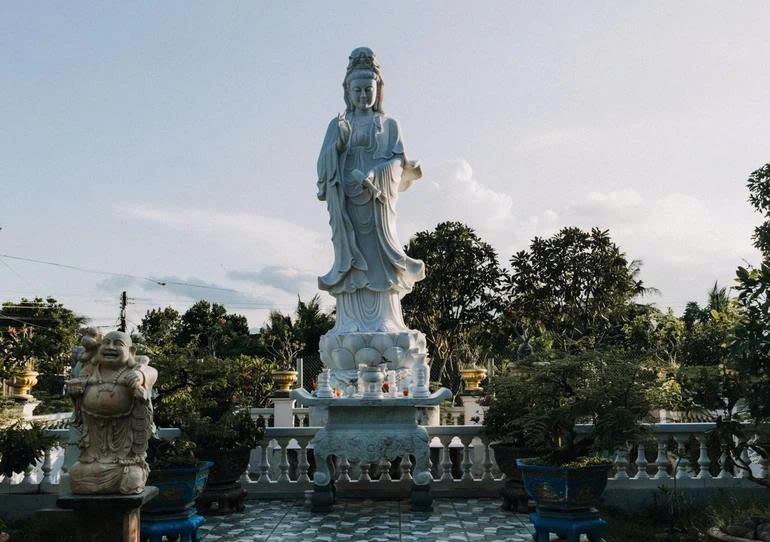
Mahayana Buddhism, also known as the Mahayana Buddhist tradition, has made breakthroughs in adapting to new circumstances and contributing positively to life through service and assistance, both spiritually and materially. Today, when natural disasters occur anywhere, the image of monks, nuns, and Buddhist followers dedicating themselves to relief efforts in the spirit of compassion has become familiar. This article offers some thoughts on the spirit of compassion in Buddhism during natural disasters in Vietnam.
First, let's limit the spiritual meaning of compassion to helping and supporting individuals or communities in need, especially in the context of natural disasters like storms and floods... Bhikkhu Bodhi has an article, translated into Vietnamese as "Compassion for one person is saving the world," published in the Giac Ngo Weekly, issue 1328. The author writes:
“Compassion is not just a gentle emotion arising in the mind, but a change in how we see the world… Compassion is the vibration of the heart before the suffering of others. When we see others as subjects, we open our hearts to their needs, recognize their suffering, listen to their cries for help, and respond with appropriate actions… When we help someone get a meal or escape poverty and become self-sufficient, we are acting from the awareness that we and they are inseparably connected, that our subjectivity resonates with their subjectivity. Saving a life is saving a subject, and thus saving an entire world, an entire universe.” "Pillar."
We ourselves are subjects, and we see others as subjects just like ourselves. In this way, when we suffer, we will feel the pain of others as if it were our own. In the verses on spreading loving-kindness (Metta Sutta), we are taught that we must first cultivate loving-kindness within ourselves before we can extend it to others, from those near to those far, from loved ones to strangers. Following this method, we need to demonstrate compassion starting with caring for and supporting those close to us, then extending it to others. In the Sangha, the Buddha taught that members should first care for and support each other, then extend their compassion to others. This spirit of compassion needs to be promoted and widely developed within the monastic community today.
Compassion in the face of natural disasters during the time of Buddha
The reason why the Buddha preached the Jewel Sutra, part of the Minor Sutras, is that “While the Buddha was residing at the Veluvana Monastery in Rajagaha, Magadha, the people of Vesali, the capital of Vajji, were simultaneously afflicted by three calamities: a devastating famine, harassment by demons (non-humans, Yakshas, etc.), and a spreading epidemic that caused many deaths.” The people invited the Buddha to Vesali to help and alleviate the calamities and epidemics. The Buddha, having observed and understood the causes of the calamities, then preached the Jewel Sutra and taught the assembly to recite it. As a result, the people were freed from the calamities (1). The story shows that the Buddha and the Sangha demonstrated compassion in helping the people spiritually, that is, through practice and the power of practice to transform calamities and bring peace.
Buddhist history shows that during the time of the Buddha, the monastic community lived by traveling and begging for alms. They did not have their own temples, and their possessions were very simple, only enough to meet the basic needs of a person. Monasteries (modern-day temples) existed, but they were communal and built and donated by lay people. The monks had small houses as their dwellings, but these were also very simple. Furthermore, according to Buddhist precepts, monks were not allowed to keep money or valuable possessions, so the monastic community certainly could not express compassion through material assistance to the people. The monks themselves could only support each other with simple material things such as offering and sharing clothing, alms bowls, shoes, or personal belongings within a limited scope because the rules did not permit the keeping of private property. From this, we also understand that monks demonstrate compassion through their practice and teaching people spiritually, while providing material assistance is difficult (due to regulations prohibiting hoarding), except for sharing food if generous offerings are received.
Compassion in the face of natural disasters today
Compassion, expressed through helping others, can be considered a Bodhisattva vow in Mahayana Buddhism. Today, the nomadic lifestyle is no longer suitable, although alms-gathering still exists in some places. All monks belonging to the Sangha or the Buddhist community worldwide must live in temples and monasteries, and their residences are regulated by the state, except for some small communities living in forests where the government permits.
Throughout the history of human development in general and religion in particular, any religious organization wishing to survive must change and adapt to the circumstances and people of the new era. The spirit of compassion in Mahayana Buddhism is an inevitable trend for adaptation, survival, and service to humanity according to new needs. This spirit of compassion must be expressed both materially and spiritually. Therefore, a Buddhist organization cannot survive and thrive without a material foundation and capable individuals to maintain and serve humanity. This is evidenced by the current state of Buddhism in Vietnam and the world.
In Vietnam, monasteries (temples, hermitages, etc.) are listed in the Law on Beliefs and Religions (2016, Chapter I) and the Charter of the Vietnam Buddhist Sangha (2022, Article 50) as religious institutions belonging to the Sangha. Typically, monasteries have a representative manager, either an abbot or a Board of Abbots or a Management Board appointed by the Sangha. The abbot is responsible for overseeing, maintaining, and developing the monastery in terms of practice and physical facilities. Thus, the monastery depends on the abbot, and the abbot's ability and objective conditions for development are crucial. An abbot with competence and widespread public influence will find it easier to develop the monastery's physical facilities, and vice versa. Objective conditions also play a significant role in the development of the monastery's physical facilities. In large cities where the population is more affluent, the abbot can more easily solicit donations to develop the monastery's facilities. Conversely, in rural or remote areas where the population is still poor, the abbot finds it difficult to mobilize local donations to develop the monastery's infrastructure, unless there is assistance from the city.
Natural disasters such as storms and floods occur everywhere, but they often affect remote areas that are already struggling materially. In Vietnam, storms and floods mainly affect the mountainous regions of the North and the central coastal areas, causing significant material damage and loss of life. Monasteries in these areas are also not immune to these "natural disasters." When storms or floods damage the monastery's facilities, the abbot is the one who has to work hard to repair them. Monasteries that are already struggling become even more so, just as the people who are already poor become even poorer.
Demonstrating compassion, Buddhist organizations, sects, and especially large monasteries have actively mobilized material resources from Buddhists and benefactors, or contributed from their own funds, to provide assistance to monasteries damaged by storms and floods, helping them overcome difficulties. This practical action demonstrates the spirit of compassion and mutual support within the Sangha. Timely assistance provides additional motivation and strength to the affected monasteries, giving them a sense of security and resilience to overcome challenges. It also embodies the spirit of harmony, the foundation for unity among members and the creation of a strong organization.
It is noteworthy that despite the damage caused by the natural disaster, the monasteries still upheld the spirit of compassion and dedication to service by collaborating with Venerable Monks and Nuns, and benefactors to help the poor in the disaster-stricken areas by distributing meals, sharing instant noodles and water, giving gifts, and offering encouragement. This selfless service demonstrates compassion and humanity during the floods, a truly noble act.
Buddhism develops according to the principle of "adapting to circumstances while remaining unwavering," adapting to real-world situations and needs. Individuals can choose to practice themselves in various ways, as long as it benefits themselves and the majority. The Buddha underwent a period of severe asceticism, but after that, he dedicated himself to teaching and guiding people. Therefore, the phenomenon of wandering monks practicing asceticism is a personal choice, but disrupting the spiritual lives of others is inappropriate. Furthermore, when natural disasters occur, compassion cannot be expressed in a purely ascetic way, but must be demonstrated through dedicated service and assistance. This is what Buddhism has always done and continues to do, adapting to circumstances.
Natural disasters bring death, loss of life, and material destruction, but it is also from these adverse circumstances that Buddhism clearly demonstrates its spirit of compassion through dedicated service and relief efforts; at the same time, it promotes the spirit of harmony through practical actions, showing the bonds of fellowship, brotherhood, friendship, and ultimately, the most beautiful human compassion.
Tags: